common:Generic
common:TrapShape
kcc5:KCC_PlaneCurveTrapBase
kcc5:KCC_KepplersFoliumTrap
common:Generic
common:TrapShape
kcc5:KCC_PlaneCurveTrapBase
kcc5:KCC_KepplersFoliumTrap
|
|||||||||
| PREV CLASS NEXT CLASS | FRAMES NO FRAMES | ||||||||
| SUMMARY: NESTED | FIELD | CONSTR | METHOD | DETAIL: FIELD | CONSTR | METHOD | ||||||||
Object
class
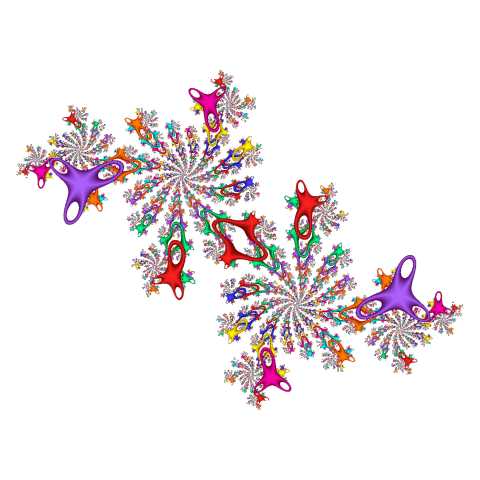
The Keppler's Folium trap.
For an example of what this trap looks like,
click here.
 class KCC_KepplersFoliumTrap( KCC_PlaneCurveTrapBase ) {
 ; The Keppler's Folium trap.
 ; <p>
 ; For an example of what this trap looks like,
 ; <a href="../additional/kcc5/images/Keppler's Folium Trap.jpg">click here</a>.
 ;
 public:
   import "common.ulb"

   ; constructor
   func KCC_KepplersFoliumTrap( Generic pparent )
     KCC_PlaneCurveTrapBase( pparent )
   endfunc

   ; call this before each sequence of values to be trapped
   func Init( complex pz )
     KCC_PlaneCurveTrapBase.Init( pz )
   endfunc

   ; call this for each iteration being trapped
   float func Iterate( complex pz )
     pz = ApplyRatioAndSize( pz )

     x = real( pz )
     y = imag( pz )

     ; Compute the Keppler's Folium Curve.
     pz = @fn1(((@fn2(x^@shapeAdjust3)-@shapeAdjust2)^2+ \
          @fn3(y^2+(1-@shapeAdjust4)))*(@fn4(x+(1-@shapeAdjust5))* \
          (@fn5(x-(@shapeAdjust6-1))-@shapeAdjust2)+@fn6 \
          (y^(1+@shapeAdjust7)))-4*@shapeAdjust1* \
          (abs(@fn7(x+(@shapeAdjust8-1)))-@shapeAdjust2)* \
          @fn8(y^(2*@shapeAdjust9)))-@distort

     ; Check to see if the point is trapped.
     return KCC_PlaneCurveTrapBase.Iterate( pz )
   endfunc

   float func GetTextureValue()
     return m_Texture
   endfunc

 protected:
   float x
   float y

 default:
   title = "Keppler's Folium Trap"

   int param v_KCC_KepplersFoliumTrap
     caption = "Version (KCC_KepplersFoliumTrap)"
     default = 100
     hint = "This version parameter is used to detect when a change has been \
             made to the formula that is incompatible with the previous version. \
             When that happens, this field will reflect the old version number to \
             alert you to the fact that an alternate rendering is being used."
     visible = @v_KCC_KepplersFoliumTrap < 100
   endparam

   float param distort
     caption = "Fission"
     hint = "Generally stretches and splits the elements"
     default = 0
     visible = @adv
   endparam

   float param shapeAdjust1
     caption = "Shape Adj. I"
     default = 1.0
     hint = "Shape adjustment parameter I."
   endparam

   float param shapeAdjust2
     caption = "Shape Adj. II"
     default = 1.0
     hint = "Shape adjustment parameter II."
   endparam

   float param shapeAdjust3
     caption = "Shape Adj. III"
     default = 1.0
     hint = "Shape adjustment parameter III."
     visible = @adv
   endparam

   float param shapeAdjust4
     caption = "Shape Adj. IV"
     default = 1.0
     hint = "Shape adjustment parameter IV."
     visible = @adv
   endparam

   float param shapeAdjust5
     caption = "Shape Adj. V"
     default = 1.0
     hint = "Shape adjustment parameter V."
     visible = @adv
   endparam

   float param shapeAdjust6
     caption = "Shape Adj. VI"
     default = 1.0
     hint = "Shape adjustment parameter VI."
     visible = @adv
   endparam

   float param shapeAdjust7
     caption = "Shape Adj. VII"
     default = 1.0
     hint = "Shape adjustment parameter VII."
     visible = @adv
   endparam

   float param shapeAdjust8
     caption = "Shape Adj. VIII"
     default = 1.0
     hint = "Shape adjustment parameter VIII."
     visible = @adv
   endparam

   float param shapeAdjust9
     caption = "Shape Adj. IX"
     default = 1.0
     hint = "Shape adjustment parameter IX."
     visible = @adv
   endparam

 ;--------------------------------------------------------------------
 ; Adjustment Functions applied to the formulas.
 ;--------------------------------------------------------------------

   func fn1
     default = abs ()
     hint = "Changes the shapes of the elements and their relations to each other"
     visible = @adv
   endfunc

   func fn2
     default = ident ()
     hint = "Changes the shapes of the elements and their relations to each other"
     visible = @adv
   endfunc

   func fn3
     default = ident ()
     hint = "Changes the shapes of the elements and their relations to each other"
     visible = @adv
   endfunc

   func fn4
     default = ident ()
     hint = "Changes the shapes of the elements and their relations to each other"
     visible = @adv
   endfunc

   func fn5
     caption = "Function 5"
     default = ident ()
     hint = "Changes the shapes of the elements and their relations to each other"
     visible = @adv
   endfunc

   func fn6
     caption = "Function 6"
     default = ident ()
     hint = "Changes the shapes of the elements and their relations to each other"
     visible = @adv
   endfunc

   func fn7
     caption = "Function 7"
     default = ident ()
     hint = "Changes the shapes of the elements and their relations to each other"
     visible = @adv
   endfunc

   func fn8
     caption = "Function 8"
     default = ident ()
     hint = "Changes the shapes of the elements and their relations to each other"
     visible = @adv
   endfunc
 }
| Constructor Summary | |
|---|---|
KCC_KepplersFoliumTrap()
|
|
KCC_KepplersFoliumTrap(Generic pparent)
constructor |
|
| Method Summary | |
|---|---|
float |
GetTextureValue()
Get texture value. |
void |
Init(complex pz)
call this before each sequence of values to be trapped |
float |
Iterate(complex pz)
call this for each iteration being trapped |
| Methods inherited from class kcc5:KCC_PlaneCurveTrapBase |
|---|
ApplyRatioAndSize |
| Methods inherited from class common:TrapShape |
|---|
GetColorChannel, GetTransformedPoint, IterateSilent, SetThreshold |
| Methods inherited from class common:Generic |
|---|
GetParent |
| Methods inherited from class Object |
|---|
|
| Constructor Detail |
|---|
public KCC_KepplersFoliumTrap(Generic pparent)
public KCC_KepplersFoliumTrap()
| Method Detail |
|---|
public void Init(complex pz)
Init in class KCC_PlaneCurveTrapBasepublic float Iterate(complex pz)
Iterate in class KCC_PlaneCurveTrapBasepublic float GetTextureValue()
TrapShapeOrdinarily, a trap shape does not have a native texture (it is flat). Some formulas may pair trap shapes with trap textures, and may need more information about trap textures when trap shapes are nested via TrapShapeMerge. This function provides support for accessing texture information.
GetTextureValue in class KCC_PlaneCurveTrapBase
|
|||||||||
| PREV CLASS NEXT CLASS | FRAMES NO FRAMES | ||||||||
| SUMMARY: NESTED | FIELD | CONSTR | METHOD | DETAIL: FIELD | CONSTR | METHOD | ||||||||